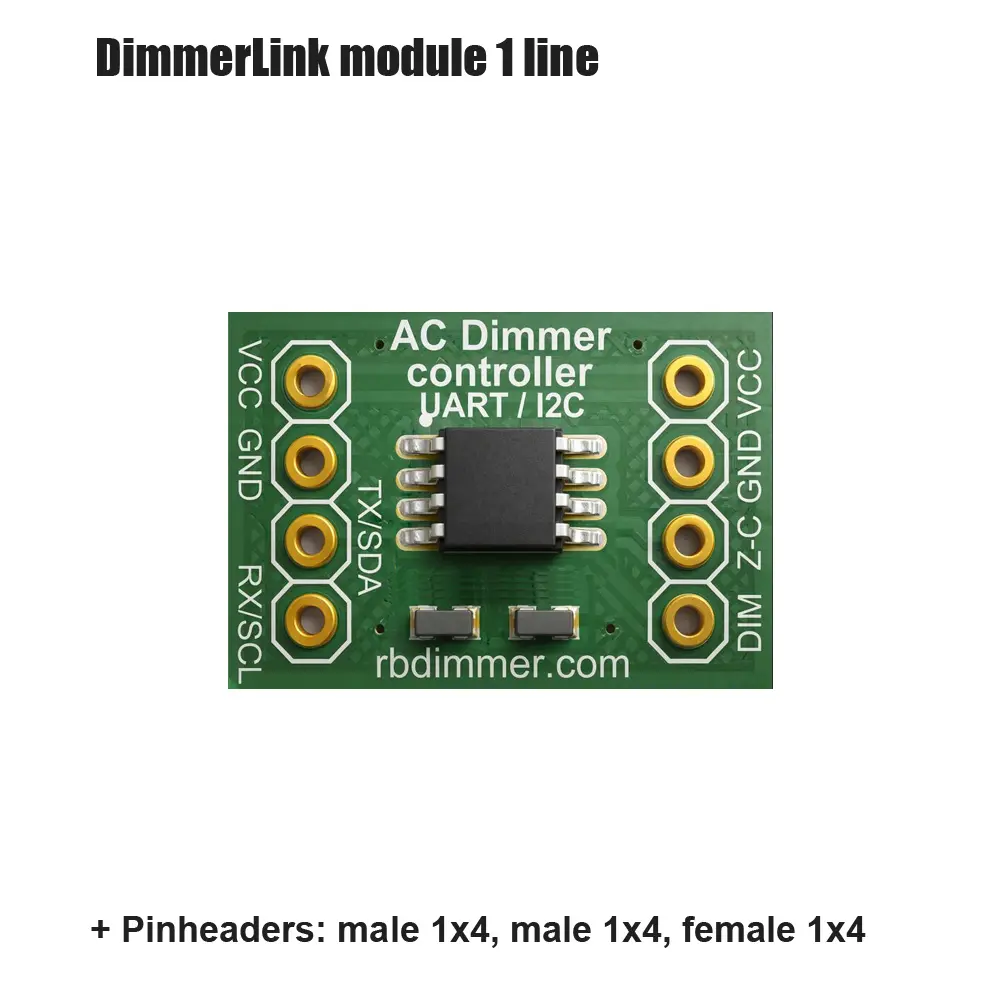


DimmerLink Controller — UART/I2C Interface for AC Dimmers
✅ ZERO FLICKERING — Dedicated Cortex-M+ handles all timing-critical operations. No software delays, no interrupt conflicts, no flicker.
✅ NOW IN 1/2/4 CHANNEL VERSIONS — Output pins match RobotDyn 2CH and 4CH TRIAC dimmer pinouts. Plug directly onto the dimmer or connect via jumper wires. Male & female pin headers included.
✅ NO LIBRARY REQUIRED — Send simple 3-4 byte commands over UART or I2C. Works with any programming language. Literally 5 lines of code.
✅ FEWER PINS, LESS LOAD — Multi-channel versions handle all timing internally. No need to run separate timers per channel on your MCU. Control 2 or 4 dimmers through a single UART/I2C connection.
✅ UNIVERSAL COMPATIBILITY — Arduino, Tasmota, ESPHome, ESP32, ESP8266, Raspberry Pi, STM32, or any MCU with UART/I2C. Supports 1.8V, 3.3V, and 5V logic levels.
✅ DUAL INTERFACE — UART (115200 8N1) or I2C (0x50). Switch anytime via command. Both use same simple protocol.
✅ SMART DIMMING CURVES — Linear, RMS (for incandescent), Logarithmic (for LED). Individual curve per channel. Auto-detects 50/60Hz mains frequency.
✅ ULTRA COMPACT — Standard 0.1" pin headers. Fits in any project enclosure.
✅ PLUG & PLAY — Connect, power on, send command. Working dimmer in under 5 minutes. Detailed documentation included.
Stop fighting with dimmer libraries. DimmerLink is a tiny plug-and-play controller that handles all the complex TRIAC timing for you. Just send simple commands over UART or I2C — the DimmerLink controller does the rest. Now available in 1-channel, 2-channel, and 4-channel versions.

THE PROBLEM WE SOLVE
Every maker knows the pain: you integrate an AC dimmer library into your project, and suddenly your lights flicker, your timing breaks, and you spend hours debugging interrupt conflicts. With multi-channel setups it gets even worse — your MCU has to manage separate hardware timers for every channel, eating up resources and creating timing collisions. The DimmerLink eliminates this entirely by offloading all timing-critical operations to a dedicated Cortex-M+ microcontroller.
HOW IT WORKS
Connect DimmerLink between your MCU (Arduino, ESP32, Raspberry Pi, or any microcontroller) and your AC dimmer module. Send a 3-byte command like "SET CH0 50%" over UART or write to an I2C register. The controller handles zero-cross detection, phase angle calculation, and TRIAC triggering with microsecond precision for all channels simultaneously. No libraries to install. No interrupts to configure. No conflicts with your existing code.
The 2-channel and 4-channel versions have output pin sequences that match the RBdimmer 2CH and 4CH TRIAC dimmer modules directly — you can plug the DimmerLink straight onto the dimmer header, connect with jumper wires, or use a flat cable. Male and female 2.54mm pin headers are included in the package.
KEY FEATURES
- Zero flickering — hardware-based timing on all channels, immune to software delays
- 1 / 2 / 4 channel versions — matches RobotDyn TRIAC dimmer pinouts for direct connection
- Single bus, multiple channels — control all channels through one UART or I2C connection instead of wiring separate pins per dimmer
- Universal interface — UART (115200 baud) or I2C (address 0x50)
- Wide voltage range — works with 1.8V, 3.3V, and 5V logic levels
- Ultra-compact — standard 0.1" pin pitch, fits anywhere
- Multiple dimming curves — Linear, RMS, Logarithmic — individually configurable per channel
- Auto frequency detection — works with 50Hz and 60Hz mains
WHY MULTI-CHANNEL MATTERS
Without DimmerLink, controlling a 4-channel dimmer from an ESP32 requires 4 GPIO pins for dimming outputs + 1 zero-cross input, plus running 4 independent hardware timers with microsecond-precision ISRs — all competing for CPU time with your WiFi stack, sensors, and other tasks.
With DimmerLink 4CH: your MCU uses just 2 pins (SDA + SCL) or 2 pins (TX + RX). One simple command sets any channel. The Cortex-M+ handles all four timing-critical outputs from a single zero-cross signal with zero jitter. Your MCU is free to do what it does best — run your application logic.
Perfect for heater control, coffee roasters, reflow ovens, solar routers, lighting automation, and any project where stable multi-channel dimming matters.
Specifications:
| Parameter | 1CH | 2CH | 4CH |
| Model | RBD-DML-1 | RBD-DML-2 | RBD-DML-4 |
| Dimmer Channels | 1 | 2 | 4 |
| Interfaces | UART / I2C (switchable) | UART / I2C (switchable) | UART / I2C (switchable) |
| UART Settings | 115200 baud, 8N1 | 115200 baud, 8N1 | 115200 baud, 8N1 |
| I2C Address | 0x50 (7-bit) | 0x50 (7-bit) | 0x50 (7-bit) |
| I2C Speed | 100 kHz (Standard Mode) | 100 kHz (Standard Mode) | 100 kHz (Standard Mode) |
| Supply Voltage | 1.8V / 3.3V / 5V DC | 1.8V / 3.3V / 5V DC | 1.8V / 3.3V / 5V DC |
| Logic Levels | 1.8V / 3.3V / 5V | 1.8V / 3.3V / 5V | 1.8V / 3.3V / 5V |
| Dimming Range | 0–100% | 0–100% per channel | 0–100% per channel |
| Dimming Curves | Linear, RMS, LOG | Linear, RMS, LOG (per ch) | Linear, RMS, LOG (per ch) |
| AC Frequency | 50/60 Hz (auto-detect) | 50/60 Hz (auto-detect) | 50/60 Hz (auto-detect) |
| Processor | Cortex-M+ | Cortex-M+ | Cortex-M+ |
| Dimensions | 18 × 12 mm | 18 × 13.6 mm | 31 × 10 mm |
| Input Pins | VCC, GND, TX/SDA, RX/SCL | VCC, GND, TX/SDA, RX/SCL | VCC, GND, TX/SDA, RX/SCL |
| Output Pins | VCC, GND, Z-C, DIM0 | VCC, GND, Z-C, DIM0, DIM1 | VCC, GND, Z-C, DIM0–DIM3 |
| Connector Pitch | 2.54mm (0.1") | 2.54mm (0.1") | 2.54mm (0.1") |
| Dimmer Compatibility | Any TRIAC dimmer | TRIAC dimmer 2CH | TRIAC dimmer 4CH |
| Included | Male + female headers | Male + female headers | Male + female headers |
| Operating Temp | −20°C to +70°C | −20°C to +70°C | −20°C to +70°C |
| Default Interface | UART (factory) | UART (factory) | UART (factory) |
Overview
- Quick Start
- Hardware Connection
- UART Communication
- I2C Communication
- Single Board Computers
- Advanced Usage
- FAQ & Troubleshooting